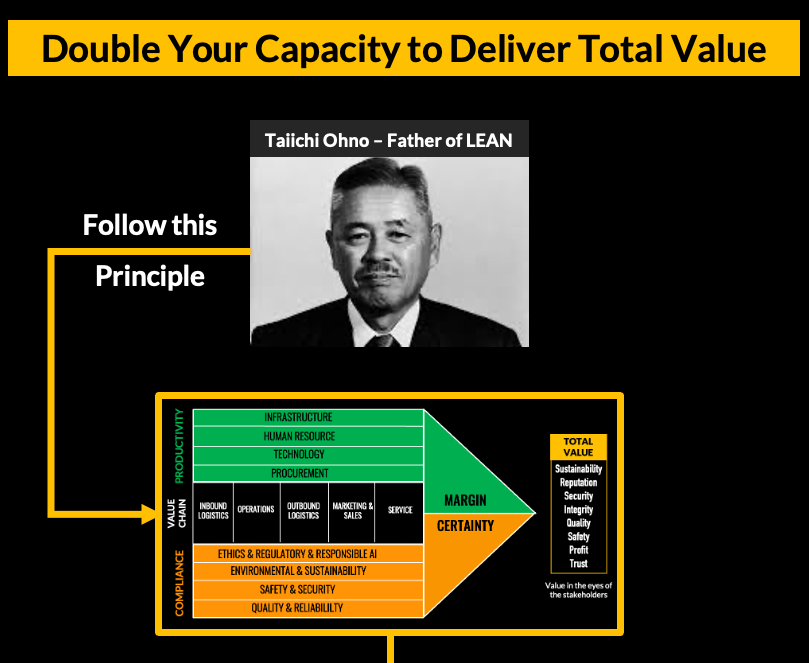
Investing in the Opportunity to Succeed


Every business creates value under uncertainty.
Some of that uncertainty can be reduced. It comes from what the organization does not yet know. About its processes. Its risks. Its obligations. The conditions it works in. Learning reduces it. So does capability. This is uncertainty you buy down.
Some of it cannot be reduced. Variation is part of real conditions, and no amount of learning removes it. This is uncertainty you contend with by creating margin.
Businesses succeed when they do both. They buy down what can be known. They hold margin against what cannot.
Where compliance fits
Compliance programs are how organizations buy down uncertainty. Uncertainty about their obligations, and uncertainty about the outcomes of those obligations.
Every obligation carries the risk that it will not be met. A regulation. A commitment. A promise to a stakeholder. Until the organization has the capability to deliver on it, whether it gets met is an open question. A compliance program closes that question. Not by documenting the obligation, but by building what it takes to meet it.
The outcomes carry uncertainty too. Safety is not produced by meeting safety obligations alone. Neither is security, or quality, or sustainability. Each one is something the organization is working toward in conditions it does not fully control. The compliance program is what reduces the uncertainty of getting there.
Margin is the other half. Where uncertainty cannot be reduced, the response is buffer, tolerance, and reserve. Enough room that variation does not become failure.
This is why compliance measured against profit alone misses most of what it produces.
What Total Value accounts for
Businesses create more than profit. Reputation. Integrity. Quality. Safety. Security. Sustainability. And underneath all of them, stakeholder trust.
These are outcomes the organization has committed to and stakeholders rely on. They are also the outcomes most exposed to uncertainty, because each one depends on something going right that could have gone otherwise.
Total Value accounts for all of it. What a business earns, and what it protects and ensures.
The third advantage
Michael Porter identified two sources of competitive advantage through value chain analysis. Cost and differentiation. Compete on price, or compete on what the product does.
There is a third.
An organization that reliably delivers on what it has committed to earns something competitors cannot easily copy. It stays between the lines, ahead of risk, and on mission. Stakeholders come to rely on it. That reliance is difficult to build and slow to lose.
We call this the Total Value Advantage.
It does not come from managing compliance more efficiently. It comes from building the capability to meet obligations, and from contending well with the uncertainty between an obligation and its outcome.
Is your compliance ready for the age of intelligence?
The Compliance Readiness Scorecard gives you an honest picture of where your program stands — and a strategic conversation about what to do next.