
The Foundations of Lean Compliance


Lean Compliance rests on foundational principles drawn from promise theory, cybernetic regulation, and value chain analysis. This article presents the logical progression that connects these principles and demonstrates why they necessarily lead to a different understanding of compliance itself.
Understanding Obligations and Promises
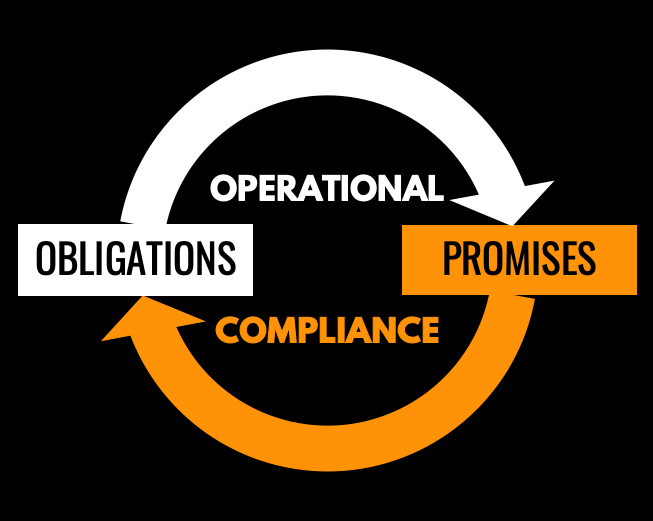
Compliance is fundamentally about meeting obligations. For compliance to be successful, these obligations must be operationalized through the fulfillment of promises associated with each obligation. This connection is grounded in Promise Theory, which recognizes that organizations make voluntary commitments to maintain cooperative relationships with their stakeholders.
Regulatory obligations come in four distinct types based on what they require and at what level they operate. The four types determine whether compliance requires procedural adherence (means) or outcome achievement (ends), at either specific (micro) or systemic (macro) levels. To meet these obligations, organizations must develop operational capabilities to fulfill their commitments—to keep their promises.
Compliance as Regulation
Compliance fulfills promises through regulation—regulating organizational effort to achieve targeted outcomes. This includes static controls, but more importantly, dynamic cybernetic systems that adapt and respond through feedback and feedforward controls.
The Foundation: Lean Thinking
Lean is about creating value by eliminating waste in operations. Waste is the manifestation of risk that has become reality. The root cause of both waste and risk is uncertainty, which lean practitioners call variation or variability.
The Core Insight: Regulation Reduces Variation
The act of regulation—through feedback and feedforward controls—reduces variation and variability. This is the fundamental principle underlying both Lean Six Sigma in operations and compliance functions like quality management and safety programs. Both regulate processes to reduce uncertainty.
Expanding Value: From Shareholder to Stakeholder

Traditional Value Chain Analysis measures value as financial margin, optimized for shareholder value. Michael Porter developed VCA as a tool for achieving competitive advantage through superior margin creation. However, modern organizations must create value for all stakeholders: customers, employees, communities, regulators, the environment, and shareholders.
This expansion requires redefining value beyond margin to include quality, safety, security, sustainability, ethics, and trust. These aren't optional extras—they are obligations and promises to stakeholders. By extending VCA to encompass these dimensions, we create a more comprehensive model that affords management better decision-making tools for achieving competitive advantage in today's stakeholder-driven environment.
From Productivity to Total Value
Value Chain Analysis reveals secondary activities designed to improve productivity—the traditional domain of lean and operational excellence, focused on margin creation.
Achieving Total Value requires more. Total Value includes financial margin plus quality, safety, security, sustainability, and ethics, plus value as perceived through the eyes of all stakeholders. This requires activities that improve certainty rather than just productivity. This is the domain of certainty programs and the practice of Lean Compliance.
The Integrative Force: Certainty + Productivity Programs
Productivity programs use regulation to reduce variation and improve margins. Certainty programs use regulation to reduce uncertainty and ensure Total Value is created. Together, these programs serve as an integrative force within the value chain, ensuring both shareholder and stakeholder value.
Conclusion

Lean Compliance is not compliance adapted to lean thinking. It is the natural extension of lean principles into the domain of certainty—making visible what has always been implicit in Total Value creation. These foundational principles enable practical applications including compliance streams, operational compliance models, and cybernetic governance systems that transform external obligations into internal operational capability.
This is Lean Compliance.


